

One founder's anxiety
and what Incorruptible taught me about protecting what you build

Way back in 2011, I found myself riveted listening to an author talk about his publishing experience. The author was Eric Ries, and the book was The Lean Startup — just then in its infancy but already en route to becoming the “little blue bible” of Silicon Valley.
We publishers were thick in the throes of the digital transition. Benign ambivalence to the new ebook format aside, most of the drama related to tensions across the value chain. From authors to publishers to retailers to consumers, everyone — but most especially we publishers — were under intense pressure to justify our share of the pie. What, exactly, were we for in this new world?
The reckoning was good for us. It forced clarity about our role: publishers are not printers, nor are we distributors. Our job is to be the best possible partner to the author — not only in creating the best book, but in trying to solve the infernal discovery problem (in a rising sea of content, how do we persuade someone to buy this book?).
Back to Eric’s talk. It was part of a conference hosted in the Random House “cafetorium” on the 2nd floor at 1745 Broadway. There were other speakers, but Eric is the only one whose words stuck.
Whether or not you’ve read The Lean Startup, you have likely absorbed at least some of its lessons and language (”pivot,” “MVP”). Eric was teaching the value of moving away from the traditional, long-lead industrial development cycle and toward the virtuous cycle of rapid build → measure → learn, repeat. The lean methodology was so widely adopted by builders of all kinds that it’s hard to remember when it wasn’t gospel.
But while we as Eric’s publisher were proudly — and successfully — supporting him and his message, it was clear from his talk that we were very, very far from absorbing the method into our own business practices. In the kindest way possible, Eric mapped out the whole of the publishing process, pointing to every juncture where he’d hoped for testing and iteration and instead found an opaque and rigid assembly line.
I scribbled pages of notes as he spoke and, much to the likely annoyance of colleagues, took to hounding everyone about his explicit and implicit points. Why couldn’t we change to allow for adaptations based on reader signals? Why couldn’t we give the author full transparency at every stage of the process? Why couldn’t we accept that an author might know more than we did — not just about the words inside a book, but about how to build and activate an audience?
Publishing has evolved in many ways over the last fifteen years. That transitional period gave birth to the Random House Author Portal (h/t to my current colleagues Nina and Andrea for that!) — still the best in the business at providing authors open access to sales, marketing, and royalty data. Production and go-to-market cycles have become at least somewhat more flexible, though with a long way to go. Many publishers have embraced opportunities to test covers and campaigns, and to use their backlists as living laboratories for pricing and program development.
So why is there still, often, resistance to new ideas? Why is the process still relatively opaque and rigid? Why is there still an allergy to the idea that authors might know more than we do? Usually, however it’s articulated, the honest answer comes down to scale.
It’s easy to make dramatic changes in process when you’re adapting to the needs of a single author. It’s much, much harder when you’re publishing hundreds of authors a year and being measured on the volume of profit you extract.
From an entrepreneurial perspective, this industry challenge is Authors Equity’s opportunity. Publishing one book at a time means focus and flexibility are built into the foundation. And since learning from our authors is one of our primary team goals, the partnership presupposes an openness to their ideas.
But could this advantage erode over time? As months pass, the list grows. Even at our current rate of about 20 new books per year, that still means an ever-expanding population of past, present, and future books — all in need of our customized, very human attention.
If our value to authors is derived from our defiance of industrial efficiency, does that mean we can’t scale?
How do we grow while staying true to our mission?
I know I’m not alone with this founder’s anxiety, and that’s one of the very many reasons I’m glad to be reunited with Eric Ries.
The Lean Startup gave a generation of founders the tools to build quickly, to scale, and to create massive value. But, as Eric now writes: “I failed to anticipate what came next. I taught people how to build something worth protecting — but not how to protect it.”
While examples from tech are likely the ones that will spring to mind first, the graveyard filled with once-good intentions comes from across all industries.
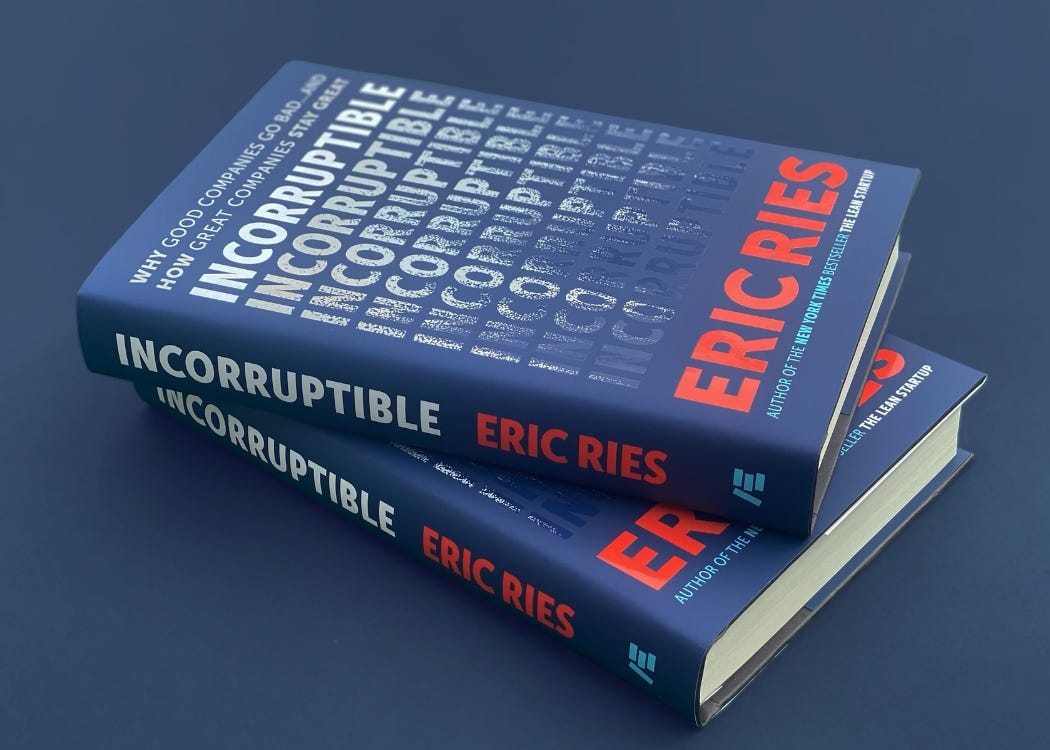
Eric has thought long and hard about remedies. He’s studied two centuries of capitalist history, foraging for the secrets to better outcomes. Some of his answers are wonderfully pragmatic — tied to governance and structure. Others are refreshingly radical, like creating a new definition of profit itself.
Incorruptible: Why Good Companies Go Bad…And How Great Companies Stay Great hits bookstores next Tuesday, but the ideas inside have been hard to contain.
Already, Dan Heath has called it “the best and most important business book of the year.” And, already, Eric’s hearing from new waves of founders and leaders hungry for the wisdom and help it offers.
What does it actually take to build an incorruptible company? We’ll be back with Eric next week — if you have a burning question, leave it in the comments below.
— Madeline
This is fascinating. Maybe this is a nonfiction I'll *actually* read!?
And speaking of transparency, the very fact that you openly shared these "but how will we scale?" founder-questions meets the mark. I'm excited to have a front seat to this new publishing model.
Resonating so hard with this piece, I just might turn into a fossil. 😂
(yes, am paraphrasing the genius writers from Succession)